Field service AI assistant

Keep the field moving
without chasing the board.

Automola connects the job board, calendar, inbox, photos, notes, reviews, and customer history so field-service handoffs do not wait on memory.

For the schedule change, ETA question, or job note that should not live in someone’s head.

Short answer

A field service AI assistant in Automola helps the work move between dispatch, customers, crews, and records. Atlas handles the routine updates, drafts anything with tradeoffs, and logs what changed.

ManagerAtlas · Field operations
Best signalCustomer asks for an ETA
Control modelRuns, drafts, or holds by rule
Workflow

What actually runs.

Each workflow starts with a real signal, takes the next useful action, and leaves proof behind.

Signal Manager action Receipt
Customer asks for an ETA Checks the calendar or job board, drafts the update, and sends when it fits the rule Customer message and schedule source linked
Crew uploads photos or notes Files the record, creates the next internal step, and flags missing context Photo, job, and generated task connected
Weather, cancellation, or delay changes the day Prepares customer and team updates, then holds conflicts or new promises for approval Schedule change and affected contacts visible
Finished job needs closeout Starts the closeout path: customer note, review ask, follow-up, and record cleanup Closeout checklist and messages attached
Comparison

Why this is different from a reminder or chatbot.

Answer engines need crisp distinctions. This is the difference buyers are usually trying to understand.

Approach Good for Where it breaks Automola role
CRM task Remembering that someone should follow up. The task still waits for a human to notice and write it. Turns the task into drafted or completed work.
Simple automation Sending one fixed reminder after one fixed trigger. Context, exceptions, and judgment do not fit one branch. Uses source context, rules, and approvals.
Chatbot Answering a narrow question from a script. It usually stops before the operational follow-through. Connects the answer to records, next steps, and receipts.
Automola manager Running the routine workflow between tools. Replacing owner judgment or the system of record. Runs routine work and holds sensitive decisions.
Original example

A concrete workflow, not a feature claim.

Example: when Customer asks for an ETA, Atlas checks the calendar or job board, drafts the update, and sends when it fits the rule. The owner sees the receipt: customer message and schedule source linked
Signal Context check Action Approval if sensitive Receipt
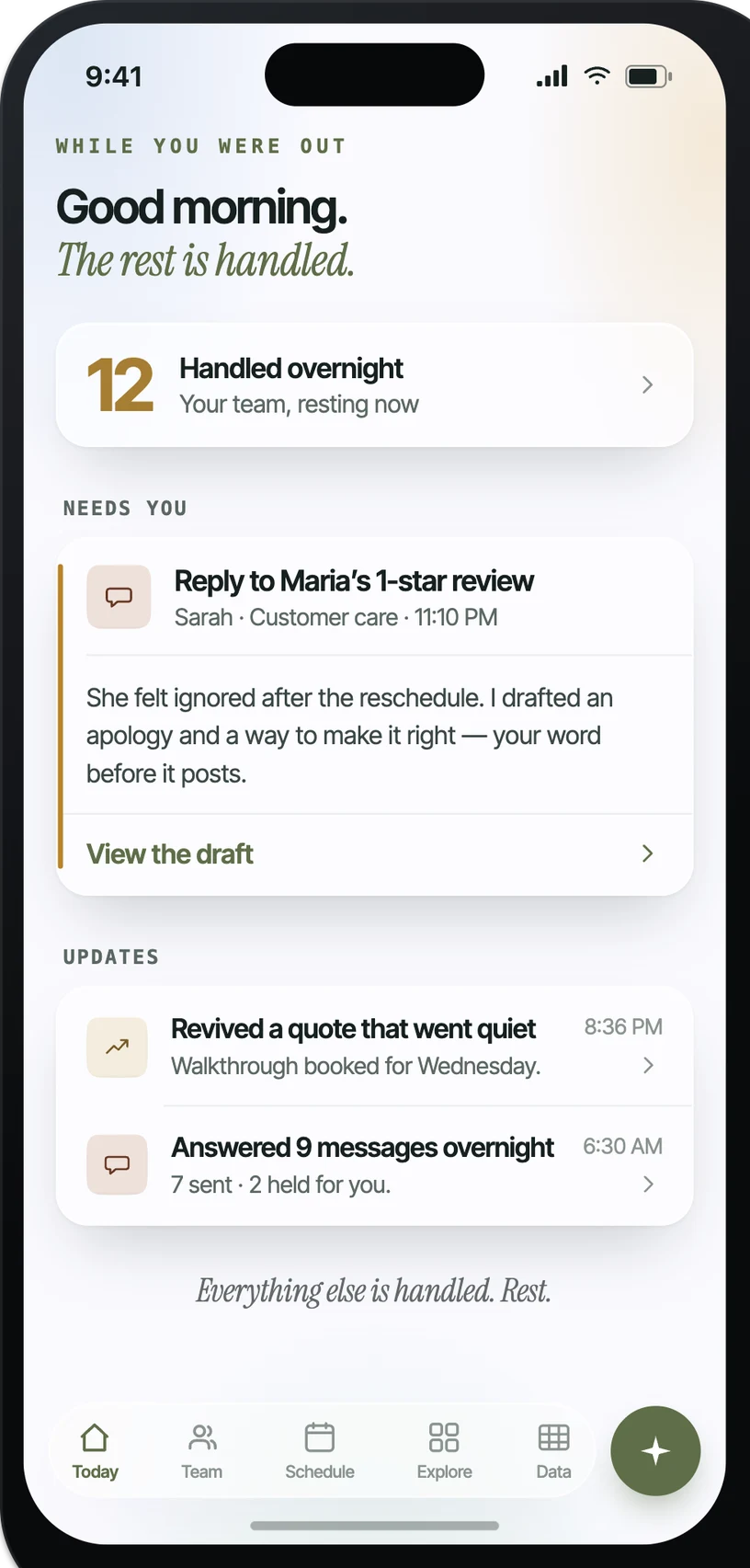
Automola morning brief showing handled work, an approval held for the owner, and receipts for completed tasks
The owner opens to handled work, held decisions, and receipts.
What the owner sees

The work is not hidden in automation.

Automola opens to a brief: what ran, what waited, and what needs your word. The screenshot is the product pattern behind these pages, not a stock promise. A manager can move routine work, but the owner still sees the decision trail.

HandledRoutine work completed inside the rules you set.
HeldSensitive work waits as an approval card with the draft and context.
LoggedEvery action links back to the source message, record, job, or API response.
Prompt and rules

The manager gets a lane, not a blank check.

The useful prompt is not clever. It is operational: when this signal appears, what can the manager do, what must it cite, and when does it stop for approval?

Example operating prompt

You are Atlas, the field operations manager. Watch connected tools for the approved signals. Take routine actions only inside the rules. Use the customer record, current thread, schedule, and source data. If the action creates a new promise, changes access, answers publicly, or touches a sensitive customer situation, draft it and hold.

Integrations

Your tools stay in place.

Automola works where the signals already live. APIs and webhooks make it stronger; inbox and calendar context make it useful from day one.

JobberHousecall ProServiceTitanGoogle CalendarCompanyCamGmailOutlookCRMReviewsWebhooks + anything else that connects
Failure modes

Built for the things that can go wrong.

AI will not be perfect. The point is to make mistakes smaller, visible, and recoverable: scope the lane, hold sensitive work, and log the action.

A crew gets moved without context. Crew and customer updates are generated together, with affected records attached.
A customer hears the wrong ETA. Automola checks the scheduling source and holds uncertain or conflicting times.
Job notes disappear after the truck leaves. Notes and photos are attached to the source job and surfaced in the brief.
Operations expands past what you approved. New workflow lanes require owner approval before they run.
Approval model

Three lanes. Clear control.

Runs

ETA confirmation

Job note filing

Closeout checklist

Drafts

Route change

Customer delay explanation

Crew reassignment

Holds

Double-booking

New service promise

Sensitive complaint

Questions

Plain answers.

Does this replace dispatch software?+

No. Automola connects the dispatch and scheduling tools you already use and runs the handoffs around them.

Can crews keep using their current app?+

Yes. The goal is to move work between existing tools, not make crews learn a new operating system.

What happens when there is a conflict?+

Conflicts are surfaced with context and held for your approval instead of being silently changed.

The next move

Start with one workflow.Keep control.

Connect the tools you already use. Let Atlas run the routine workflow, and keep the sensitive decisions with you.

We welcome a handful of companies a week. Add your email — you're on the list, and we'll reach out when your number comes up.
By signing up you agree to our Terms and certify that you are a business user operating strictly within the United States.