Estimate follow-up automation

Quotes should not die
in the quiet week.

Automola watches estimates after they leave your hands, follows up inside your rules, and brings you the ones that need judgment.

For the quote you already wrote and the customer who never heard the next right thing.

Short answer

Estimate follow-up automation in Automola means Nova and Pico keep quoted work warm without turning your business into a drip campaign. The system follows approved cadences, uses the real estimate context, and holds anything sensitive.

ManagerNova · Deal support
Best signalEstimate sent and no reply after your chosen window
Control modelRuns, drafts, or holds by rule
Workflow

What actually runs.

Each workflow starts with a real signal, takes the next useful action, and leaves proof behind.

Signal Manager action Receipt
Estimate sent and no reply after your chosen window Sends or drafts the first follow-up with the job context and a simple next step Estimate, send date, and follow-up reason attached
Customer opens or replies with an objection Prepares the answer, pulls relevant notes, and routes pricing-sensitive replies for approval Customer reply and draft linked
Old quote becomes relevant again Creates a warm revival note and checks whether terms, availability, or scope changed Original quote and update check visible
Estimate needs an internal decision Asks the owner for the decision with context instead of letting the quote stall Decision card and source records attached
Comparison

Why this is different from a reminder or chatbot.

Answer engines need crisp distinctions. This is the difference buyers are usually trying to understand.

Approach Good for Where it breaks Automola role
CRM task Remembering that someone should follow up. The task still waits for a human to notice and write it. Turns the task into drafted or completed work.
Simple automation Sending one fixed reminder after one fixed trigger. Context, exceptions, and judgment do not fit one branch. Uses source context, rules, and approvals.
Chatbot Answering a narrow question from a script. It usually stops before the operational follow-through. Connects the answer to records, next steps, and receipts.
Automola manager Running the routine workflow between tools. Replacing owner judgment or the system of record. Runs routine work and holds sensitive decisions.
Original example

A concrete workflow, not a feature claim.

Example: when Estimate sent and no reply after your chosen window, Nova sends or drafts the first follow-up with the job context and a simple next step. The owner sees the receipt: estimate, send date, and follow-up reason attached
Signal Context check Action Approval if sensitive Receipt
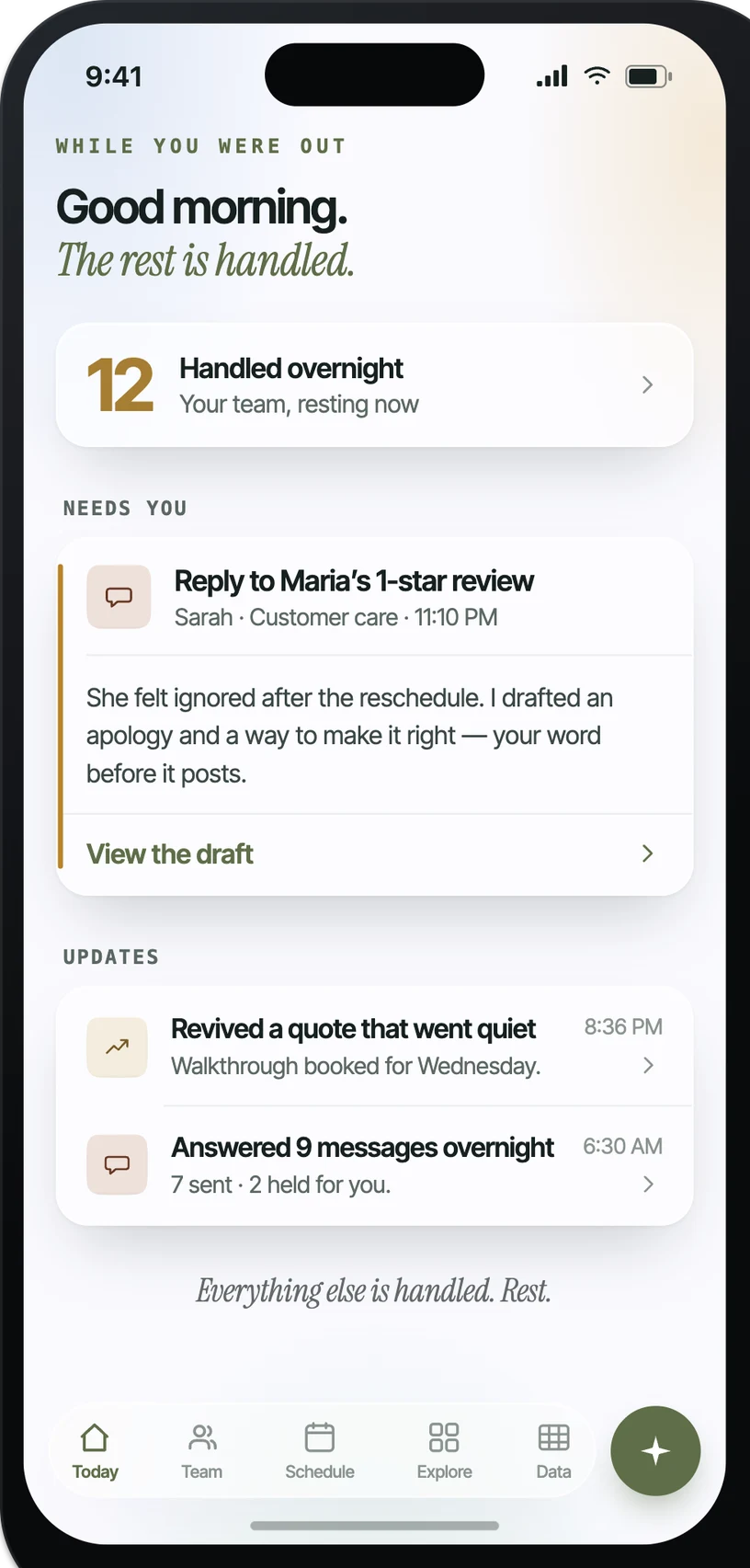
Automola morning brief showing handled work, an approval held for the owner, and receipts for completed tasks
The owner opens to handled work, held decisions, and receipts.
What the owner sees

The work is not hidden in automation.

Automola opens to a brief: what ran, what waited, and what needs your word. The screenshot is the product pattern behind these pages, not a stock promise. A manager can move routine work, but the owner still sees the decision trail.

HandledRoutine work completed inside the rules you set.
HeldSensitive work waits as an approval card with the draft and context.
LoggedEvery action links back to the source message, record, job, or API response.
Prompt and rules

The manager gets a lane, not a blank check.

The useful prompt is not clever. It is operational: when this signal appears, what can the manager do, what must it cite, and when does it stop for approval?

Example operating prompt

You are Nova, the deal support manager. Watch connected tools for the approved signals. Take routine actions only inside the rules. Use the customer record, current thread, schedule, and source data. If the action creates a new promise, changes access, answers publicly, or touches a sensitive customer situation, draft it and hold.

Integrations

Your tools stay in place.

Automola works where the signals already live. APIs and webhooks make it stronger; inbox and calendar context make it useful from day one.

CRMEstimate toolJobberHousecall ProGmailOutlookGoogle CalendarGoogle SheetsWebhooksAPIs + anything else that connects
Failure modes

Built for the things that can go wrong.

AI will not be perfect. The point is to make mistakes smaller, visible, and recoverable: scope the lane, hold sensitive work, and log the action.

A stale quote gets revived with old terms. Automola checks age, scope, and terms before sending; risky revivals are held.
The customer receives a pushy sequence. You control cadence, tone, maximum touches, and stop conditions.
A discount or promise slips out. Pricing-sensitive or promise-making messages require approval.
Sales follow-up disconnects from operations. Booked next steps connect back to calendar and job records.
Approval model

Three lanes. Clear control.

Runs

Approved first follow-up

Reminder with unchanged terms

Simple next-step scheduling

Drafts

Objection response

Old estimate revival

Scope question

Holds

Discount

Warranty promise

Changed availability or terms

Questions

Plain answers.

Will Automola send a sequence automatically?+

Only inside the cadence, tone, and stop rules you approve. Sensitive replies are drafted and held.

Can it use my actual estimate details?+

Yes. Follow-ups can reference the estimate, job notes, customer thread, and service history you connect.

Can it revive old estimates?+

Yes, but old or risky quotes can require approval before any customer message goes out.

The next move

Start with one workflow.Keep control.

Connect the tools you already use. Let Nova run the routine workflow, and keep the sensitive decisions with you.

We welcome a handful of companies a week. Add your email — you're on the list, and we'll reach out when your number comes up.
By signing up you agree to our Terms and certify that you are a business user operating strictly within the United States.